ChatGPT Ads Targeting: How Context-Based Ad Matching Works
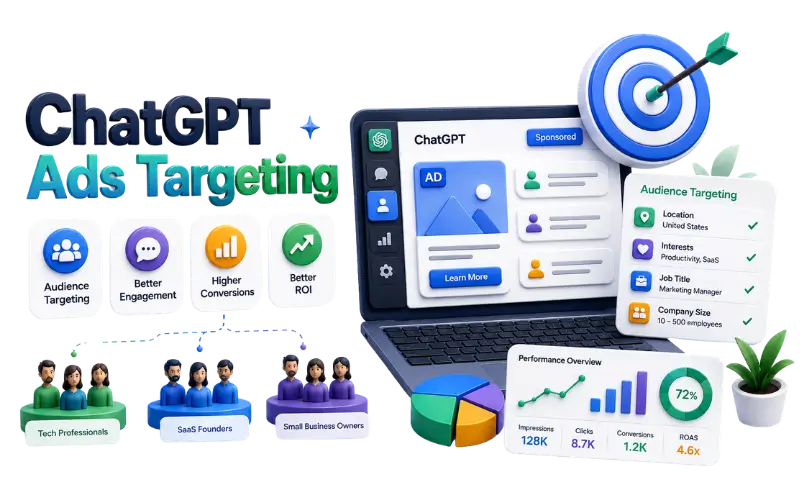
Different ad platforms rely on different signals to decide when an ad may be relevant. On Google, keywords play an important role. On Meta, audience signals are commonly used. ChatGPT adds something different to the mix: the context and intent of a conversation.
This means the system can consider what the user is talking about and what they may be looking for. That conversation context can help determine whether an available ad may be relevant.
The Basic Unit: Context Hints
A context hint is a short description advertisers add to an ad group. It explains the type of user need or situation where a product or service may be relevant.
Advertisers use these hints to give the system more information about when their product or service may fit. Context hints are added at the ad-group level, so each ad group can focus on a particular type of need or situation.
A simple way to think about a context hint is:
Person → Need → Situation
For example:
Broad term:
“CRM software”
More detailed context hint:
“Supply chain managers looking for tools to reduce manual reporting.”
The second version gives more detail about who may need the product and what they are trying to solve.
This is not an official OpenAI formula. It is simply an easy way to write a more useful context hint.
| Keyword Approach | Context-Hint Approach |
|---|---|
| Uses words or phrases | Describes a situation |
| “CRM software” | “Supply chain managers looking for tools to reduce manual reporting” |
| Focuses on a search term | Focuses more on the need behind it |
| Often uses keyword lists | Uses short descriptions |
Context hints should describe a clear need without becoming too narrow. OpenAI also recommends allowing for different ways people may describe the same problem.
Why a Keyword Works Differently Here
A keyword usually tells you what someone searched for. A context hint can explain more about the situation behind that search.
Someone typing “best CRM for healthcare” into Google gives a short search query.
In ChatGPT, the same person may explain what they need in more detail. They might describe their current process or mention a specific problem.
That extra information gives more context.
This is why simply copying an old keyword list into context hints may not be enough. A context hint works better when it explains the need behind the product or service.
For example:
Keyword:
“Accounting software”
Context hint:
“Small businesses looking to reduce manual accounting work.”
The second version gives more information about why the product may be useful.
How the Matching System Uses Conversation Context
Context hints are only one part of ad matching.
OpenAI says the system can also consider the context and intent of the current conversation. Information from the ad itself may also help with matching.
For example, someone may first ask:
“How does this kind of software work?”
That question gives only a small amount of information.
Later, the person may explain the type of software they need or mention a particular requirement.
Now the system has more context about what the person is looking for.
This does not mean ChatGPT places every user into a fixed buying stage. OpenAI has not publicly described the system that way.
It is better to think of the conversation as giving the system more information that may help with ad relevance.
Specific Requirements Can Add More Context
People may also mention specific requirements during a conversation.
Someone might mention a limited budget. Another user might say that a product needs to work without constant internet access.
These details give more information about what the person needs.
However, this does not mean every requirement becomes a strict targeting filter.
For example, we cannot assume that mentioning an offline requirement will always stop an online-only product from appearing.
OpenAI has not described a fixed targeting feature that works this way. It is safer to treat these requirements as extra context that may help the system judge relevance.
Grouping Hints by Buyer Stage
Advertisers do not need to use one broad context hint for every possible customer.
Different needs can be separated into different ad groups. OpenAI recommends separate ad groups when audiences or use cases are meaningfully different.
One practical way to organise them is by where the user appears to be in the buying process.
Exploring Stage
The user may still be learning about a problem or looking for possible ways to solve it.
For example:
“Small businesses looking for ways to reduce manual customer follow-up.”
Educational messaging may fit this kind of situation.
Comparing Stage
The user may already know what type of solution they need and be comparing different options.
For example:
“Sales teams comparing CRM tools for managing customer follow-up.”
The ad can focus more on the differences between possible solutions.
Deciding Stage
The user may appear closer to choosing a solution.
For example:
“Sales teams looking to replace their current CRM.”
A more direct offer may fit this situation.
These are practical ways to organise ad groups. They are not official buyer stages defined by OpenAI.
The main idea is simple: different needs can be placed into separate groups instead of using one hint for every situation.
Other Ways to Write Context Hints
A context hint does not always need to mention the product name.
It can describe the result someone wants.
For example:
“Finance teams trying to spend less time preparing monthly reports.”
The user does not need to say “reporting automation software.” The problem itself gives useful context.
Another approach is to describe someone looking for a different way to solve a problem.
For example:
“Teams comparing alternatives to manual project tracking.”
or:
“Businesses looking for different ways to automate customer support.”
These focus on the situation rather than only the product keyword.
You can think of them as outcome-based or comparison-focused hints. These are simple labels used for explanation here, not official OpenAI context-hint categories.
Context Hints Should Add Useful Information
A context hint should usually give the system information that is not already clear from the ad.
Suppose the ad title says:
“Automate Monthly Financial Reporting”
A context hint like:
“Financial reporting automation”
does not add much.
A clearer version could be:
“Finance teams spending too much time preparing monthly reports manually.”
Now the ad explains the solution, while the context hint explains the situation where that solution may be useful.
Context Hints Do Not Guarantee Ad Placement
A context hint does not mean an ad will appear every time a similar topic comes up.
For example:
“Small businesses looking for appointment scheduling software.”
This does not mean the ad will automatically appear whenever someone discusses appointment scheduling.
The hint simply gives the system more information about where the ad may be relevant. Other signals may also affect ad matching.
So context hints are better understood as relevance signals, not exact targeting rules.
Advertisers Do Not See the Conversation
Using conversation context for ad matching does not mean advertisers can read the user’s ChatGPT conversation.
OpenAI says advertisers do not get access to users’ chats or chat history. It also says user data is not sold to advertisers.
The system can use conversation context to help judge ad relevance without giving the conversation itself to the advertiser.
What This Means If You’re Used to Keyword Targeting
Advertisers who are used to keyword-based platforms may need to think a little differently.
A very broad hint may not give enough information.
For example:
“Accounting software”
does not explain why someone needs the software.
A clearer version could be:
“Small businesses looking to reduce manual work when preparing monthly accounts.”
This gives the system more information about the situation.
At the same time, a hint should not become so narrow that it only fits one very specific conversation. OpenAI recommends keeping hints focused while still allowing people to describe the same need in different ways.
A simple process is:
Find the Need → Describe the Situation → Group Similar Needs → Test and Refine
ChatGPT Ads is still developing, so the way advertisers use context hints may continue to change.
For now, the main difference is simple: keywords usually focus on the words someone searches for, while context hints describe the situation where an ad may be relevant.