
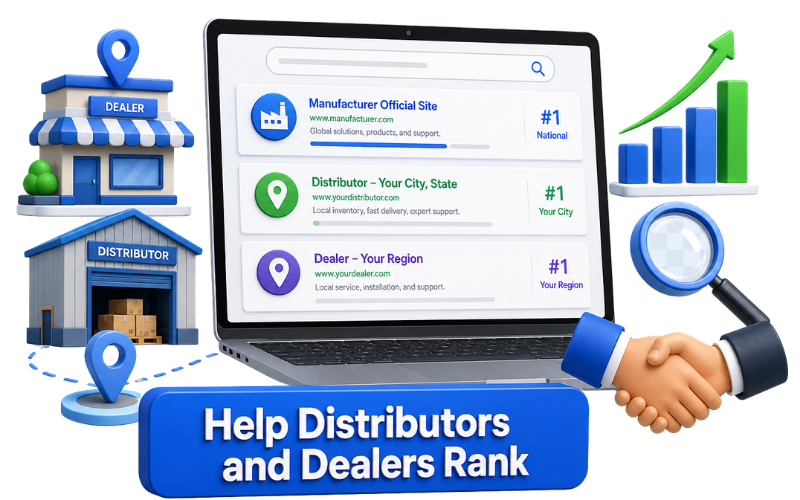
Manufacturers often sell through distributors and dealers. This means the same product may appear on several websites.
That is not automatically a problem. The problem starts when every website publishes the same product page with the same description and tries to rank for the same search.
For example, a manufacturer may have a page for an industrial pump. A distributor may create another page using the same product name, specifications, and description. If the distributor also has no additional information about stock, service, or local availability, the two pages are serving almost the same purpose.
A better approach is to give each website a different role.
The manufacturer should provide the official product information. The distributor should explain how buyers can purchase or receive support from that distributor. A regional dealer can focus on its approved territory and local service.
This gives buyers a reason to visit each page instead of finding the same information repeated across several websites.
Give the Manufacturer and Channel Partners Different Jobs
Start by deciding what each website should help the buyer with.
| Website | Main purpose |
|---|---|
| Manufacturer | Official product information and technical documents |
| National distributor | Stock availability and order coverage |
| Regional dealer | Local territory and contact information |
| Specialist distributor | Product selection for a specific application |
For example, the manufacturer might answer:
“What is this product and what are its specifications?”
The distributor can answer:
“Can I order this product from you?”
A regional dealer can answer:
“Can you supply or support this product in my area?”
The product stays the same, but each website provides information that the others may not have.
Give Partners Product Data, Not Finished Pages
Partners need accurate product information, but they do not need a complete page written by the manufacturer.
If every distributor receives the same finished description and publishes it without changes, the same content can appear across many domains.
Instead, provide a product data pack containing the information partners need.
Include:
- Approved product name
- Correct part number or model number
- Current specifications
- Product images
- Image usage instructions
- Official manuals
- Warranty information
- Required compliance wording
- Approved product claims
The distributor can then build its own page around the service it provides.
For example, the manufacturer may provide:
Product: Industrial Pump PX-450
Flow rate: 450 L/min
Maximum pressure: 16 bar
Material: Stainless steel
The distributor can use those facts but add information about its own stock, ordering process, service area, or lead-time enquiries.
This keeps the technical information consistent without forcing every website to use the same page copy.
Build a Dealer Locator That Helps Buyers
Once buyers know the product, they may need help finding a seller.
A dealer locator should make that step easy.
A useful dealer listing can show:
- Dealer name
- Territory served
- Product lines supported
- Website
- Contact route
- Quote or enquiry option
For example:
| Dealer | Territory | Product support |
|---|---|---|
| ABC Industrial Supply | Texas | Pumps and valves |
| Westline Equipment | California | Industrial pumps |
| Metro Process Systems | New York | Process equipment |
This gives buyers useful information instead of simply showing a list of company names.
Do Dealer Pages Need to Be Indexed?
Not every dealer needs a separate searchable page.
A dedicated dealer page can be useful when it contains real information about that partner, such as its territory, supported products, contact process, or local services.
A page that only changes:
“Industrial Pump Dealer in Dallas”
to
“Industrial Pump Dealer in Houston”
does not provide much additional value if everything else remains the same.
Avoid creating hundreds of location pages with almost identical content.
Avoid Manufacturer–Distributor Search Conflicts
The easiest way to avoid competition is to make the pages different before they are published.
Consider this example.
Manufacturer page
Industrial Pump PX-450
The page provides:
- Official specifications
- Product drawings
- Technical documents
- Operating information
- Warranty information
Distributor page
Industrial Pump PX-450 – Available from ABC Industrial Supply
The page provides:
- Current stock information
- Ordering process
- Local delivery information
- Distributor support
- Quote request process
Both pages can mention the same product. They do not need to compete because they answer different buyer questions.
The distributor should not simply copy the manufacturer’s complete description and add its phone number at the bottom.
Focus Distributor Pages on Information They Can Provide
A distributor has information that the manufacturer may not have on its own website.
That information can make the distributor page useful.
For example:
Stock
Is the product normally kept in stock?
Ordering
How can a buyer request a quote?
Lead time
Can the distributor provide current lead-time information?
Local support
Does the distributor provide installation or technical support?
Accessories
Can the distributor supply compatible accessories?
Only include information that the distributor can support.
If installation is not offered, the page should not claim that installation support is available.
Keep Brand and Product Names Consistent
Different page content does not mean product names should become inconsistent.
Manufacturers should give partners clear naming rules.
For example:
Approved:
PX-450 Industrial Pump
Avoid:
PX450 Pump Pro
PX 450 Heavy Duty Pump
Industrial Pump PX450X
unless those names are officially approved.
The same applies to trademarks and authorization claims.
If a distributor is officially authorized, it can use the approved wording. A company that does not have that status should not describe itself as an “authorized distributor.”
Product identifiers also need to stay consistent.
If a model changes from PX-450 to PX-450A, partners should receive the updated information and the effective date.
Old documents should not continue presenting the retired model as the current product.
Link Where the Buyer Needs the Next Step
Links between the manufacturer and partner websites should help buyers move forward.
For example:
Manufacturer product page → Dealer locator → Local distributor
Or:
Distributor product page → Official manufacturer manual
This is more useful than adding links simply because two websites are expected to link to each other.
A manufacturer does not need to place a long list of distributor links on every product page. A dealer locator can provide that route.
Likewise, a distributor can link to the manufacturer’s current manual instead of uploading an old copy.
The question should always be:
Will this link help the buyer complete the next step?
Keep Partner Information Up to Date
A good channel structure can become inaccurate when products or partnerships change.
A dealer may stop selling a product. A territory may change. A distributor may no longer provide a particular service.
Review this information regularly.
Check:
- Dealer status
- Territory
- Product authorization
- Product availability
- Contact details
- Service information
If a dealer profile is no longer valid, remove or update it.
If the old page has a suitable replacement destination, a redirect may be appropriate. Do not redirect it to an unrelated page simply because the old URL no longer applies.
Set Rules for Partner-Created Pages
Manufacturers do not need to write every distributor page themselves.
They can set minimum requirements instead.
A partner page should clearly state:
- Who is selling the product
- Which territory is served
- What service is provided
- Which product is being offered
- Which product information is current
Product claims should come from the manufacturer’s approved information.
If the manufacturer changes an important specification, partners should have a clear process for updating their pages.
For example:
Manufacturer changes pressure rating → Partner receives update → Partner updates product page
This reduces the chance of old specifications remaining online.
Use the Right Product Images
Product images also need some control.
Manufacturers should provide current images with the correct model names.
Partners should know when an image shows an optional configuration.
For example, if a pump image shows a special motor that is not included with every version, the image should not be presented as though that configuration applies to the entire product range.
Using one image for several different products can also confuse buyers when the visible features are different.
Handle Territory Overlap Clearly
Sometimes two dealers serve the same territory.
The website should not create an exclusive territory claim unless one actually exists.
For example, if two approved distributors serve Texas, the dealer locator can show both.
If one distributor only handles a particular product line, make that clear.
Also distinguish between shipping to an area and serving an area.
A distributor may ship a product nationwide but only provide local installation support in certain locations.
The page should describe the actual service rather than making a broader local claim.
Audit Product Content Across Partner Websites
After the pages are published, check whether partners are creating useful content or simply copying the manufacturer.
You do not need to remove every repeated specification.
Some information should remain the same.
For example:
Maximum pressure: 16 bar
should be identical if that is the official specification.
The bigger concern is when complete descriptions and service claims are copied across many websites.
Check for:
- Identical product descriptions
- Repeated marketing copy
- Incorrect specifications
- Outdated product names
- Unsupported service claims
- Incorrect territory information
When copied content is found, do not simply ask the partner to change a few words.
First ask:
What information can this partner provide that the manufacturer cannot?
That could be local stock, ordering information, service coverage, or application-specific guidance.
Build the page around that information.
A Simple Channel SEO Structure
A manufacturer and its partners do not need to compete for exactly the same search.
A simple structure can look like this:
Manufacturer
→ Official product information
→ Technical specifications
→ Manuals and documents
→ Product families
Distributor
→ Product availability
→ Ordering information
→ Stock or lead-time information
→ Distributor support
Dealer
→ Local territory
→ Local contact
→ Supported products
→ Local services
When each website has a clear purpose, buyers can use the site that best answers their question.
The manufacturer remains the source for official product information, while distributors and dealers can build useful pages around the services they actually provide.
That gives channel partners room to appear in search without simply creating another copy of the manufacturer’s website.