SaaS SEO Guide: Rank Higher and Convert More
SaaS SEO is one of the most powerful growth channels available to software companies. Unlike paid ads that stop the moment budget runs out, organic traffic keeps growing over time. This guide covers everything from the basics to the exact strategies that move rankings, grow traffic, and turn visitors into customers.
What Is SaaS SEO
SaaS SEO is the process of getting your software product to rank on Google. When someone searches for a tool that solves their problem and your website shows up at the top, that is SaaS SEO working.
The difference between SaaS SEO and regular SEO comes down to one thing: the business model. SaaS companies sell subscriptions, making every customer acquired through SEO worth far more than a one-time sale. That customer pays every month for years, making organic traffic far more valuable here than in almost any other industry.
Why SaaS SEO Is Different
SaaS buyers do not make impulse decisions. They research, compare, read reviews, and ask colleagues before committing. The buying journey is longer and more considered than almost any other product category.
This means SaaS SEO has to cover the entire journey: content for people who have a problem, content for people comparing tools, and content for people almost ready to sign up. Most SaaS companies only cover one stage and then wonder why SEO is not converting.
The SaaS SEO Funnel
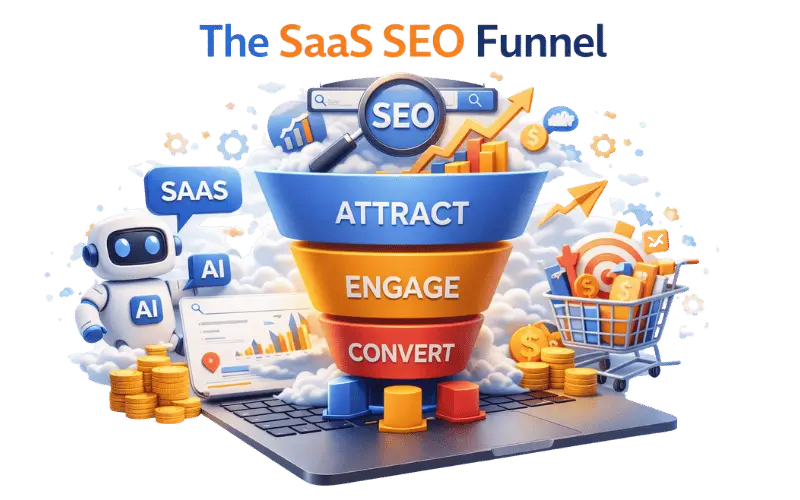
Most SaaS companies treat SEO like a single channel pointing at one type of visitor. The reality is that different people search for different things depending on where they are in their journey. Understanding this funnel is what separates companies that get signups from the ones that only get traffic.
Top of Funnel
These are people who are searching around a problem they have. They do not know your product exists and they are not looking to buy anything yet. They type things like “how to manage a remote team” or “why are projects always delayed.” They are looking for information, not a tool. The goal with this content is to answer their question well, introduce them to the idea that a tool can solve their problem, and get them into the funnel.
Middle of Funnel
These people already know that tools exist and are now comparing their options. They search for things like “best project management software” or “Asana alternatives.” They are in research mode and are actively evaluating what to try. This is the most commercially valuable stage in SaaS SEO. One well-written comparison or alternative page can drive more signups than ten top of funnel blog posts combined.
Bottom of Funnel
These people have done their research and are ready to make a decision. They search for things like your product name, your pricing, or direct comparisons against a specific competitor. The audience at this stage is smaller but the intent is the strongest of any stage in the funnel. This content converts at the highest rate of anything in SEO.
| Funnel Stage | Example Keywords | Content Type |
|---|---|---|
| Top of Funnel | “how to manage remote teams” | Blog posts and guides |
| Middle of Funnel | “best project management software” | Comparison and alternative pages |
| Bottom of Funnel | “Asana pricing too expensive” | Review and use case pages |
Keyword Research for SaaS
Keyword research is the foundation of everything. Without it, content and link building effort is pointed in the wrong direction.
The goal is to map every keyword a potential customer might search at every funnel stage. Nothing should be published without a keyword behind it.
Problem Keywords
People searching around their pain point. High volume but lower conversion intent.
Solution Keywords
People searching for tools in your category. Good conversion intent.
Comparison Keywords
People comparing specific tools against each other. High conversion intent.
Alternative Keywords
People searching for alternatives to a competitor. These are among the highest converting keywords in SaaS SEO because the searcher is already frustrated with what they have.
| Keyword Type | Example | Conversion Intent |
|---|---|---|
| Problem | “why do projects miss deadlines” | Low |
| Solution | “best project management tool” | Medium |
| Comparison | “Asana vs Monday.com” | High |
| Alternative | “alternatives to Asana” | Very High |
Technical SEO for SaaS
Technical SEO allows Google to find, crawl, and rank your website. Great content on a technically broken website will always underperform.
Page Speed
Google uses page speed as a direct ranking factor. According to Google’s own research, 53% of mobile users abandon a page if it takes more than 3 seconds to load. A mobile page speed score below 50 needs immediate attention. Compressing images, cleaning up unused code, and enabling browser caching are the most common fixes.
Indexing
Google can only rank pages it can find and index. Many SaaS websites accidentally block pages through incorrect settings left over from development. An indexing audit should be done first.
XML Sitemap
A sitemap tells Google about every page on your website. Without one, important pages often get missed.
Internal Linking
Every page should be reachable through internal links. Pages with no links pointing to them are difficult for Google to discover and rank.
Schema Markup
Structured data helps Google understand your content and can trigger rich results like star ratings and FAQs in search.
Crawl Budget
Large SaaS websites with hundreds of pages need to manage how Google spends its crawl budget. Duplicate pages, thin content pages, and unnecessary URL parameters waste crawl budget that should be spent on the most important pages.
Core Web Vitals
Google measures three specific user experience signals on every page: how fast the main content loads, how quickly the page responds to the first user interaction, and how stable the layout is while loading. Poor Core Web Vitals scores directly suppress rankings.
Canonical Tags
SaaS websites often create duplicate content through URL variations, filtered views, or pagination. Canonical tags tell Google which version of a page is the original so link equity is not split across duplicates.
| Technical Element | Why It Matters | Priority |
|---|---|---|
| Page Speed | Ranking factor and user experience | Critical |
| Indexing | Pages not indexed cannot rank | Critical |
| Internal Linking | Distributes authority across pages | High |
| XML Sitemap | Helps Google discover all pages | High |
| Schema Markup | Enables rich results in search | Medium |
| Core Web Vitals | Direct ranking factor for user experience | Critical |
| Canonical Tags | Prevents link equity being split across duplicates | High |
Content Strategy for SaaS SEO
Content is what earns rankings. But not all content earns rankings equally. The SaaS companies that win at SEO are not the ones publishing the most content. They are the ones publishing the right content, built around keywords their potential customers are actually searching for, consistently every month.
Long-form Blog Posts
These target top of funnel problem keywords. The goal is not just to rank but to genuinely help the reader solve a problem. A post that actually helps someone earns longer time on page, more shares, and more natural backlinks over time. Aim for 1,800 to 2,500 words and end with a clear call to action toward a free trial.
Comparison Pages
These target middle of funnel keywords where someone is evaluating tools. The key to making these pages work is honesty. A comparison page that acknowledges where competitors are strong, while clearly showing where your product wins, builds far more trust than one that reads like a sales pitch.
Alternative Pages
These target people searching for alternatives to a specific competitor tool. This audience is already frustrated with what they are using. They are not browsing. They are actively looking to switch. If your content shows up at that moment and makes a clear case, a strong percentage of them will try your product.
Use Case Landing Pages
These target bottom of funnel keywords for specific customer types and industries. “Project management software for marketing teams” speaks directly to one audience with one specific value proposition. These pages convert at high rates because the message matches exactly what the visitor was searching for.
Glossary and Definition Pages
These define industry terms and concepts. They build topical authority over time and consistently rank for long-tail keywords that bring in a steady stream of relevant visitors who are early in their research.
| Content Type | Funnel Stage | Primary Goal |
|---|---|---|
| Long-form Blog Posts | Top | Build awareness and topical authority |
| Comparison Pages | Middle | Capture people comparing tools |
| Alternative Pages | Middle | Capture people ready to switch tools |
| Use Case Pages | Bottom | Convert specific audience segments |
| Glossary Pages | Top | Build topical authority over time |
Link Building for SaaS
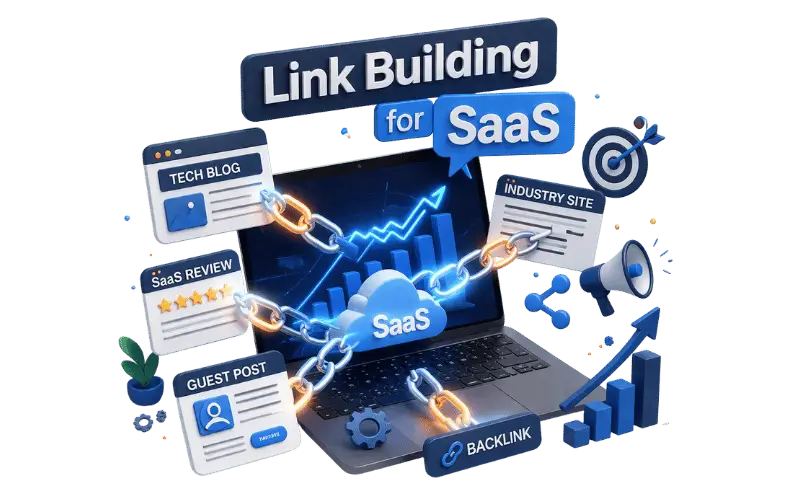
Links from other websites are one of the strongest ranking signals Google uses. Strong content with weak backlinks will always be outranked by competitors with stronger link profiles.
Guest Posts
Write original articles for relevant blogs in your industry. Include a natural link back to your website. One link from a high authority website is worth more than twenty links from low authority websites.
Broken Link Recovery
Find broken links on other websites pointing to content similar to yours. Reach out to the site owner and suggest your content as a replacement. This works because you are doing the site owner a favour while earning a link.
Business Listings
Getting listed on business directories and SaaS-specific platforms builds links and drives direct referral traffic. These are easy to set up and should be done early in any SEO engagement.
Software Review Platforms
Getting listed on review platforms builds links and drives referral traffic from people actively researching tools in your category.
Original Research
Publishing original data earns natural links from writers and bloggers who cite it. A well-promoted research post can earn dozens of links without active outreach.
Partner Mentions
If your product integrates with other tools, partner with those companies for mutual mentions and links.
| Link Building Method | Link Quality | Scale Potential |
|---|---|---|
| Guest Posts | High | High |
| Original Research | Very High | Medium |
| Broken Link Recovery | High | Medium |
| Business Listings | Medium | High |
| Software Review Platforms | Medium | Low |
| Partner Mentions | Medium | Low |
Conversion Optimization for SaaS SEO
Getting organic traffic is only half the job. The other half is converting that traffic into free trial signups. Most SaaS websites leave significant conversion improvement on the table.
Homepage CTA Placement
The free trial button should be visible without scrolling. If a visitor has to scroll to find how to sign up, a percentage of them will not bother.
Contextual Blog CTAs
Every blog post should end with a call to action specific to the topic. A generic “learn more” link converts far worse than “Try our tool free — manage your remote team in under 10 minutes.”
Pricing Page Clarity
The pricing page is where many visitors make their final decision. It needs to be clear, address common objections, and include an FAQ covering questions people ask before signing up.
Exit Intent
Visitors about to leave a blog post can be captured with an exit intent popup offering something valuable. A free template or checklist keeps them in the funnel even if they are not ready to sign up today.
| Optimization | Typical Conversion Lift |
|---|---|
| Contextual blog CTAs | 100 to 300% |
| Pricing page rewrite | 50 to 150% |
| Homepage CTA above fold | 15 to 30% |
| Exit intent popup | Captures 2 to 5% of exits |
Measuring SaaS SEO Performance
SEO results take time. The first two to three months are mostly foundation work. Months four through six show early ranking movement. Month seven onwards is where compounding growth becomes visible.
Organic Traffic
Total visitors coming from Google each month. Track in Google Analytics and compare month over month.
Keyword Rankings
Which keywords are ranking and at what position. The goal is to see keywords moving toward page one over time.
Backlink Growth
Total backlinks and quality of those links over time. Domain Authority is a useful proxy metric.
Organic Signups
Free trial signups attributed to organic search. This connects SEO directly to revenue.
Cost Per Acquisition
The cost of acquiring one customer through SEO versus paid ads. As organic traffic grows, this number should fall significantly.
| Metric | What to Track | Review Frequency |
|---|---|---|
| Organic Traffic | Total visitors coming from Google each month | Monthly |
| Keyword Rankings | Which keywords are ranking and at what position | Weekly |
| Organic Signups | Free trial signups attributed to organic search | Monthly |
| Domain Authority | How trusted the site is on a scale of 0 to 100 | Monthly |
| Backlink Growth | Total backlinks earned and quality over time | Monthly |
| Cost Per Acquisition | Cost of acquiring one customer through SEO vs paid ads | Monthly |
Common SaaS SEO Mistakes
Publishing without keyword research
Content written without keyword research is guesswork. It may occasionally rank but it will never build consistent, compounding traffic.
Waiting to build links
Links need time to have an impact. Starting link building late means waiting longer for rankings to move. Link building should start in the first week alongside everything else.
Ignoring the middle of the funnel
Most SaaS companies publish top of funnel blog content and bottom of funnel product pages. Comparison and alternative pages are where the highest converting traffic lives. Leaving them uncovered means leaving signups on the table.
Fixing technical issues last
Technical SEO problems suppress the performance of every other effort. Fix them first.
Measuring too early
SEO compounds over time. Expecting significant results at month two or three leads to abandoning strategies that would have paid off significantly by month seven.
How Long Does SaaS SEO Take
There is no honest answer that involves a short timeframe. SEO compounds. The typical trajectory looks like this:
| Period | What Happens |
|---|---|
| Month 1 to 2 | Technical fixes, keyword research, first content live, link building begins |
| Month 3 to 6 | Early rankings appear, traffic starts moving, compounding begins |
| Month 7 plus | Strong organic engine running, traffic growing consistently |
Companies that see the best results commit to consistent execution for at least twelve months. The channel rewards patience and punishes inconsistency.
SaaS SEO Tools
The right tools make SaaS SEO easier to manage. They help with keyword research, technical checks, content updates, link building, and rank tracking. Using the right mix can save time and make decisions clearer.
Ahrefs
Ahrefs is widely used for keyword research, backlink analysis, competitor research, and rank tracking. It helps show what people are searching for, how hard keywords may be to rank for, and which competitor pages are earning links.
SEMrush
SEMrush covers keyword research, site audits, rank tracking, and competitor analysis. It is especially useful for finding technical issues on larger websites and is often used alongside Ahrefs.
Google Search Console
Google Search Console is free and essential for any website. It shows indexed pages, impressions, clicks, rankings, and crawl or indexing issues directly from Google.
Google Keyword Planner
Google Keyword Planner is a free tool for basic keyword research. It gives search volume ranges and works well as a starting point before using paid tools.
Screaming Frog
Screaming Frog crawls a website page by page and helps find technical problems like broken links, duplicate tags, redirect chains, and blocked pages.
Google PageSpeed Insights
PageSpeed Insights checks page speed on mobile and desktop. It also shows what is slowing the page down and suggests ways to improve it.
Surfer SEO
Surfer SEO helps optimize content by comparing it with top ranking pages. It gives suggestions on headings, keyword use, structure, and topic coverage.
Clearscope
Clearscope focuses on content quality and topic coverage. It helps writers make sure important terms and subtopics are covered properly.
Hunter.io
Hunter.io helps find verified email addresses for websites and domains. It is useful for outreach during link building and partnerships.
SERPWatcher
SERPWatcher is a simple rank tracking tool for monitoring keyword positions over time. It works well for teams that mainly want easy ranking updates.
| Tool | Purpose | Cost |
|---|---|---|
| Ahrefs | Keywords, backlinks, rankings, competitor research | Paid |
| SEMrush | Keywords, competitor analysis, site audit | Paid |
| Google Search Console | Indexing, rankings, crawl errors | Free |
| Google Keyword Planner | Basic keyword volume data | Free |
| Screaming Frog | Full technical site crawl and audit | Free and Paid |
| Google PageSpeed Insights | Page speed scoring and fix recommendations | Free |
| Surfer SEO | Content optimization against top ranking pages | Paid |
| Clearscope | Content quality and topic coverage scoring | Paid |
| Hunter.io | Contact emails for link building outreach | Free and Paid |
| SERPWatcher | Dedicated keyword rank tracking | Paid |
Final Word
SaaS SEO is not complicated. It is consistent. Keyword research tells you what to create. Technical SEO makes sure Google can see it. Content builds the pages that rank. Link building gives those pages the authority to outrank competitors. Conversion optimization turns traffic into revenue.
Every SaaS company that ranks well on Google today started from zero. They picked the right keywords, published consistently, built links steadily, and gave it time.