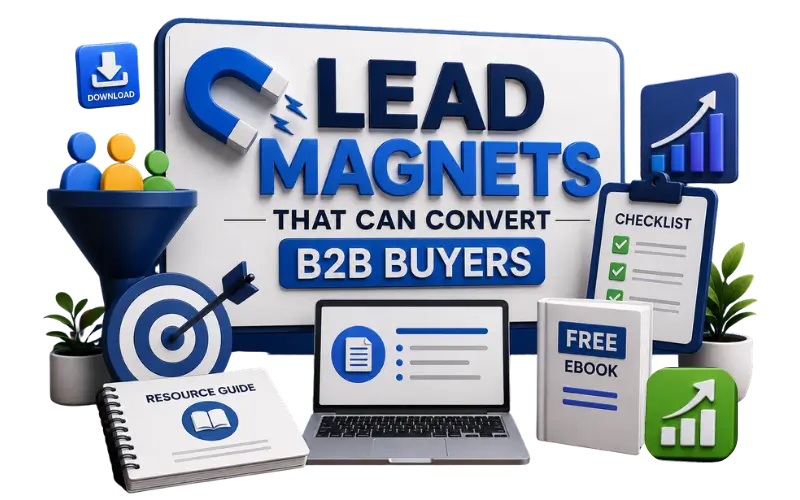
A lead magnet trades something useful for a visitor’s contact details. What goes inside it can influence whether that trade feels worth making.
This guide looks at what a strong B2B lead magnet can include, piece by piece, and how to connect it to what happens after the download.
A Few Formulas for Writing the Promise
Before picking a format or writing a word, it helps to state the promise in one clear sentence. Different situations can call for a slightly different formula.
The Outcome Formula
“For [this type of buyer], who wants [this outcome], without [this pain point], this delivers [this concrete result] in [this amount of time].”
This can work well when the resource solves a clear problem, like reducing costs or saving time.
Example: “For a marketing manager who wants lower cost-per-lead, without cutting campaign volume, this delivers a channel-by-channel cost breakdown in fifteen minutes.”
The Comparison Formula
“For [this type of buyer] trying to choose between [option A] and [option B], this delivers [a clear way to compare them].”
This can work well for later-stage buyers who already know they need something but haven’t decided which option fits.
Example: “For an operations lead trying to choose between two vendors, this delivers a side-by-side cost and feature comparison worksheet.”
The Quick-Win Formula
“For [this type of buyer], this delivers [one specific, usable thing] they can apply in [a short amount of time].”
This can work well for short lead magnets like checklists or scripts, where the value comes from speed rather than depth.
Example: “For a sales rep, this delivers a five-question discovery-call script they can use on their next call.”
The Data Formula
“For [this type of buyer] wondering how they compare to peers, this delivers [specific benchmark or data point] based on [the source of that data].”
This can work well when the resource’s main value is original research or a benchmark rather than a how-to guide.
Example: “For an HR leader wondering how their turnover compares, this delivers average turnover rates from a survey of 200 mid-size companies.”
Once one of these is filled in clearly, it can become easier to see which format fits best and what the cover or landing page headline should say. If none of them can be filled in clearly, the lead magnet may still be too broad.
A Clear, Specific Promise on the Cover
The cover or landing page needs to state what is inside rather than relying on a vague benefit statement.
A cover reading “Marketing Tips” tells a visitor very little. A cover reading “15 Email Subject Lines That Got Replies From CFOs” explains what they are getting and who it is for.
This detail can influence whether someone opens the download after receiving it. A vague promise may attract curiosity but give the reader little reason to continue. A specific promise connects the resource to a clearer need.
A Real, Usable Example Inside
Many B2B lead magnets explain a concept. Fewer show how it can be applied.
A pricing strategy guide becomes more practical when it includes a worked example, such as a sample calculation showing how a company priced three tiers using real cost inputs. A general explanation of “value-based pricing” without a worked number leaves the reader to apply the idea alone.
Buyers downloading a B2B resource are often looking for something they can compare with their own situation. A worked example can make that process easier.
Something the Reader Can Act on Immediately
A lead magnet that only explains ideas may be skimmed once and forgotten. One that includes something actionable gives the reader more reason to use it again.
A few things that can make a lead magnet immediately usable:
- A checklist the reader can check off, not just read
- A template with fields to fill in, not just a description of what it should contain
- A script or exact wording the reader can copy, rather than general advice about what to say
- A calculation or formula the reader can apply to their own numbers
A guide describing “how to structure a discovery call” may be less practical than one that includes the questions in a usable order.
Data or a Perspective the Reader Can’t Get Elsewhere
Generic advice is widely available. A lead magnet built entirely from common advice competes with information a buyer could find through search.
Original data, even something as simple as results from a small internal survey or an analysis of the company’s customer base, can give the resource something more specific. A clear point of view can also help it stand apart from a neutral summary of common knowledge.
A benchmark report based on responses from real B2B sales teams may offer more useful context than a general post explaining what a close rate is.
Enough Depth to Feel Worth the Trade, Without Padding
Length on its own doesn’t make a lead magnet feel valuable. What matters is whether every part earns its place.
A short guide where every page adds something new can feel more valuable than a long one padded with the same point restated in different words. B2B buyers often skim content quickly, which can make unnecessary padding easier to notice.
| Length | Can Work Well When | Risk |
|---|---|---|
| One to three pages | The topic is narrow and the value is immediate, like a checklist | Can feel thin if it’s mostly generic advice |
| Five to ten pages | The topic needs some explanation plus a usable tool or example | Can drift into padding if not tightly edited |
| Fifteen or more pages | The topic is genuinely complex, like a full compliance framework | Needs strong structure so it doesn’t feel like a chore to use |
What Happens Right After the Download
Right after someone downloads a lead magnet, the topic may still be fresh in their mind. What happens over the next few days can be nearly as important as the resource itself.
A simple follow-up sequence can look like this:
- Right away: send a message confirming the download. Repeat the promise and give one quick win they can use immediately.
- A few days later: send something a bit deeper, like an extra tip or a related resource.
- About a week later: connect the topic to a broader outcome. Add a soft invitation to talk or see a demo.
- Around two weeks later: send a light, low-pressure check-in. Simply offer to answer questions.
Someone who downloaded a pricing guide shouldn’t necessarily receive the same messages as someone who downloaded a hiring checklist. What they chose to download gives some indication of what they care about.
Why the Landing Page Matters as Much as the Content
A strong lead magnet can still underperform if the page offering it doesn’t explain the offer clearly.
The page should quickly explain what is inside and who it is for. It should also clarify what happens after the visitor submits the form.
A page missing this information may lose visitors who were otherwise interested. They may come close to downloading but leave because something feels unclear or unfinished.
A short preview, such as one sample page or a brief list of what’s covered, can explain the content quickly. A line stating the intended reader, such as “built for finance managers at mid-size companies,” makes the audience clear.
Why the Same Lead Magnet Can Work Differently in Different Places
Where a lead magnet is offered can change how well it performs, even when the content stays the same.
A lead magnet placed at the end of a blog post may attract readers who already understand the topic’s importance. The same resource shown as a homepage popup can reach a colder visitor who needs more context first.
An exit-intent popup shown as someone is about to leave may reach a visitor who was interested but had not planned to act. This placement needs a particularly clear and low-effort promise because the visitor was not planning to stop and read more.
Testing the same lead magnet in different placements can help show where it performs best instead of assuming one location fits all traffic.
Building More Than One Lead Magnet Over Time
A single lead magnet may not serve every buyer at every stage equally well. Over time, it can help to build a small set of resources.
An early-stage resource, like an industry benchmark or a framework for understanding a problem, can suit someone who is still exploring. A later-stage resource, like an implementation checklist or vendor comparison worksheet, may suit someone closer to deciding.
Mapping resources to specific personas and buying stages can create a set that covers different parts of the journey without repeatedly overlapping in the same area.
Trust Signals That Fit a B2B Audience
B2B buyers downloading a resource on behalf of their company may look for signs that it is credible, not just well-designed.
A few things that can support this trust:
- The author’s name and role rather than an anonymous “Team” byline
- A mention of the data source if statistics are included
- A short note on the company’s relevant experience with the topic
- Recognizable client names or logos where the company has permission to share them
A guide with no named author or sources may feel less trustworthy than one that clearly explains where its information comes from.
Keeping a Lead Magnet From Going Stale
A lead magnet that performed well at launch can lose relevance as an industry or tool changes.
Outdated statistics or a discontinued tool mentioned inside can affect credibility, especially with a buyer who knows the subject well.
Checking older lead magnets every few months can help identify these issues. Updating an existing resource may also take less time than creating a new one.