Google Updates AI Content Guidance for Publishers
Google updated its generative AI content guidance by adding information from the Search Quality Rater Guidelines. The revision provides more detail about content originality, automated publishing and quality standards for website publishers.
The update aims to align Google’s online documentation with information shared during developer events.
Two Quality Rater Sections Added to Google’s AI Guidance
Google’s updated generative AI content guidance now refers publishers to two sections of its Search Quality Rater Guidelines.
| Guideline | Focus | Explanation |
|---|---|---|
| Section 4.6.5 | Scaled Content Abuse | Covers mass-produced content created mainly to manipulate search rankings, including automated or copied pages that offer little value to users. |
| Section 4.6.6 | Low-Effort Content | Covers content created with little effort, originality or added value, such as poorly researched pages that provide limited useful information to readers. |
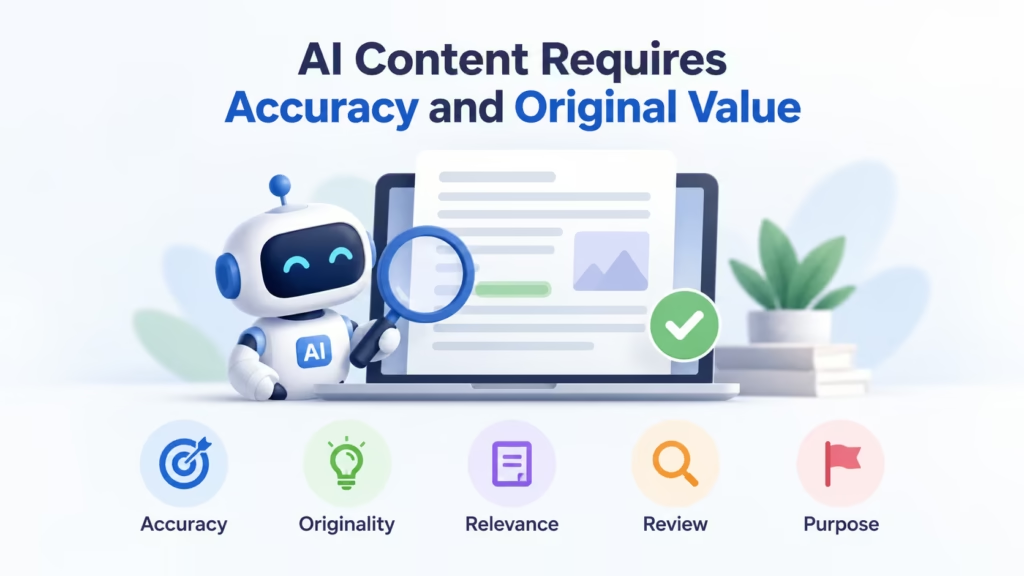
AI Content Requires Accuracy and Original Value
Google recognizes generative AI as a tool that can help with research, content planning and organizing information.
However, its scaled content abuse policy addresses large amounts of low-value content produced mainly to manipulate search rankings.
Publishers using AI tools should pay attention to several content-quality areas:
- Factual Accuracy: Check AI-generated facts, figures and technical information before publishing.
- Original Information: Include useful knowledge instead of simply repeating existing content.
- Content Relevance: Keep information closely related to the topic and readers’ needs.
- Editorial Review: Check generated material for errors, unclear statements and misleading information.
- Content Purpose: Focus on providing useful answers rather than producing pages only to target search keywords.
AI tools can support content creation, but publishers still need to check whether the final material is accurate and useful.
Google Also Addresses AI-Generated Website Metadata
The documentation covers supporting information that website owners may create using AI tools.
| Website Element | Quality Consideration |
|---|---|
| Page Titles | Clearly describe the page’s main subject. |
| Meta Descriptions | Provide an accurate summary of the content. |
| Structured Data | Match the information available on the webpage. |
| Image Alt Text | Describe images accurately and naturally. |
These elements help represent webpage information in search-related features and should remain consistent with the published content.
For B2B websites, this is relevant when AI tools are used to prepare technical articles, product pages, service descriptions and their associated metadata.
Quality Rater Feedback and Search Rankings
Google uses search quality raters to evaluate the quality and usefulness of search results. Their feedback helps Google assess how well its ranking systems are performing.
The guidance explains several important aspects of the quality evaluation process:
- Search Quality Evaluation: Raters review search results to assess content quality, relevance and usefulness.
- Ranking System Assessment: Google uses quality rater feedback to evaluate and improve its search systems.
- No Direct Ranking Impact: Individual quality ratings do not directly increase or decrease a webpage’s search rankings.
- Quality Assessment Standards: The guidelines explain how originality, effort and useful information are considered during evaluations.
Content Creation Transparency
Google’s guidance also discusses providing useful context about how content was created.
Publishers can explain the role of automation when this information would help readers understand the material.
The documentation also covers specific requirements related to AI-generated product information and images in Google Merchant Center, including appropriate labeling and image metadata.
These requirements apply to relevant Merchant Center submissions rather than every article published on a website.