Most B2B companies doing SEO are not failing because they lack content or tools. They are failing because they are doing the right things in the wrong order.
They optimise pages that should not exist yet, publish content before knowing what their buyers actually search for, and chase backlinks before the technical foundation can support them. Six months later the results are disappointing and nobody knows why.
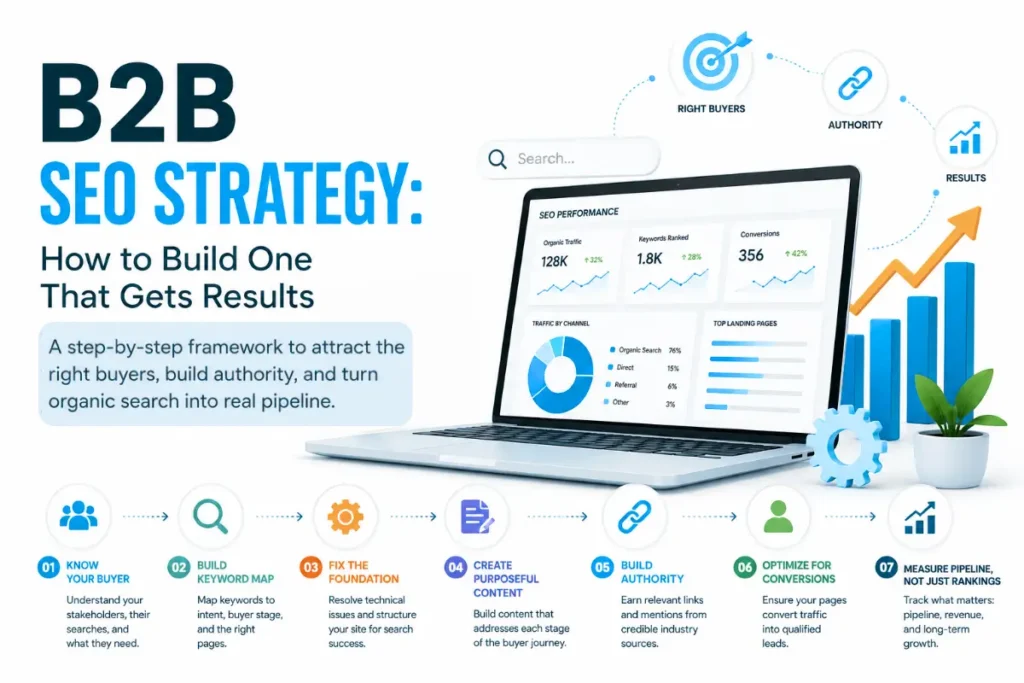
A B2B SEO strategy is a sequencing decision as much as it is a tactics decision. Every component works better when it follows the right one. This page lays out that sequence and the decisions that go inside each step.
Step One: Know Exactly Who You Are Building This For
Before touching a keyword tool or writing a single page, you need to answer one question with real specificity: who inside a buying company is searching for what you sell, and what are they afraid of getting wrong.
The Buyer Is Never One Person
A department head, an IT director, and a legal counsel can all be involved in the same purchase decision. Each one searches differently. Each one needs different content to feel confident enough to move forward.
The department head searches for operational outcomes — how will this solve the problem we have right now. The IT director searches for integration and security specifics. The legal counsel searches for compliance terms and contract risk.
If your content only speaks to one of them, the deal stalls at the person you missed.
All three are part of the same buying decision but each one searches differently at each stage of their research.
Map every stakeholder before building anything. For each one, write down what they search, what they fear, and what they need to see before they will recommend moving forward.
Talk to Recent Customers Before Opening a Keyword Tool
No persona document replaces a real conversation with someone who recently bought from you.
Ask them what they searched, what almost sent them to a competitor, and what made them reach out. Conversations like this produce more useful keyword and content intelligence than a week of tool research.
A B2B SaaS company might find that their best customers all searched “why are users dropping off after the free trial” long before they ever reached out. That search has almost no monthly volume. But it is exactly what a product leader types at 11pm when churn has become a board-level problem.
Most B2B companies skip this step entirely. Their keyword lists end up full of terms that describe what the company sells rather than what buyers actually search for.
Step Two: Build a Keyword Map, Not a Keyword List
There is a difference between a keyword list and a keyword map. A list is a collection of terms. A map assigns every term to a specific page, a specific buyer stage, and a specific intent. Without that structure, keyword research produces content decisions that make no strategic sense.
Why Volume Is the Wrong Primary Filter in B2B
The instinct to chase high-volume keywords is the single most common mistake in B2B keyword strategy.
In B2B, a keyword with 80 monthly searches from senior procurement officers will almost always outperform a broad term with 80,000 searches that attracts students and job seekers. Low volume keywords convert at dramatically higher rates because the specificity of the search itself signals buying intent.
When someone searches “cold chain logistics software for pharmaceutical distributors” they are not browsing. They are evaluating. That specificity is the signal that matters in B2B — not search volume.
Build Three Separate Keyword Lists
Your keyword strategy needs three distinct lists, each serving a different part of the buyer journey.
Problem-Aware Searches
These buyers know something is wrong but have not decided what kind of solution they need. They search problem descriptions, not product categories.
“Why is our order fulfillment error rate increasing” or “how to reduce supplier lead time variability” are awareness stage searches. The right content for these terms educates without selling.
Solution-Aware Searches
These buyers have identified what type of solution they need and are now comparing options. “Best 3PL software for mid-size distributors” or “warehouse management system comparison for manufacturers” are consideration stage searches. The right content helps buyers evaluate intelligently.
Vendor-Aware Searches
These buyers have a shortlist and are doing final validation. They search for vendor-specific information, reviews, comparisons between named competitors, and proof that companies like theirs have succeeded.
These terms have the lowest volume and the highest conversion potential on your entire site. Most B2B companies have reasonable coverage here and almost nothing at the awareness and consideration stages. That gap is why organic search brings in very few leads despite reasonable traffic numbers.
Use CPC as an Intent Signal
When evaluating keywords, pay more attention to cost-per-click data than to search volume. CPC reflects what advertisers are actually willing to pay for a click, and in B2B, advertisers only pay significant CPCs for terms that convert into real business.
A keyword with 200 monthly searches and a $35 CPC tells you something important — buyers searching this term are highly qualified and competitors are spending significant money to reach them. That is exactly the kind of keyword your organic strategy should target.
Map Keywords to Pages Before Writing Anything
Before creating a single piece of content, build a keyword map that assigns every target keyword to a specific page on your site.
Each page should own one primary keyword and a small cluster of closely related supporting terms. Two pages should never target the same primary keyword. When they do, they compete against each other in Google and both perform worse than a single well-optimised page would.
This mapping exercise also surfaces keyword cannibalization that may already exist on your site. Before creating any new content, check whether multiple pages on your site are already competing for the same term — a proper SEO audit will surface this and show exactly what needs to be fixed first.
Step Three: Fix What Is Already Broken Before Building More
This is the step that feels least like progress and matters most. Publishing new content on a technically broken site is like adding floors to a building with a cracked foundation.
Why Technical SEO Comes Before Content
A technically broken site wastes the effort put into content and links in two specific ways.
First, if Google cannot properly crawl and index your pages, new content never ranks regardless of how good it is. Pages blocked by robots.txt errors, pages set to noindex by mistake, pages buried too deep in the site structure — all of these create invisible content that Google never evaluates for rankings.
Second, if your site authority is being diluted by low value pages — old campaign pages, thin tag archives, duplicate service variations — Google’s overall assessment of your site quality is dragged down by pages that add nothing.
The Technical Issues That Actually Move the Needle
Pages buried more than three clicks from the homepage rarely accumulate enough authority to rank, and this is one of the most common technical SEO problems on B2B sites.
Every important page should be reachable in two clicks from the homepage and should have internal links pointing to it from multiple relevant pages higher in the site.
Indexation quality matters just as much. Most B2B sites have pages that should not be indexed sitting alongside the strong pages. Noindexing or removing the weak ones focuses Google’s attention on the pages that actually deserve it.
Page speed affects rankings directly and conversion rates on every page regardless of rankings. A buyer who waited months to find your site and leaves because it loads slowly is a loss that never shows up in your keyword reports.
Google’s Core Web Vitals set clear thresholds for this:
- Largest Contentful Paint — under 2.5 seconds
- Interaction to Next Paint — under 200 milliseconds
- Cumulative Layout Shift — under 0.1
Pages that consistently fail these scores lose ranking ground against competitors with similar content quality.
Sort Out Site Structure Before Creating More Pages
How authority flows between pages depends entirely on how the site is structured. A well-structured site amplifies the value of every piece of content on it. A poorly structured one limits it regardless of how good the content is.
Get the structure right before scaling content. Adding more pages to a poorly structured site makes the structural problem worse, not better.
Step Four: Create Content That Has a Specific Job to Do
With a clean technical foundation and a complete keyword map, content production becomes a precise exercise. Every page has a specific buyer, a specific keyword, and a specific role in moving that buyer forward. Nothing gets published without those three things defined first.
Service and Solution Pages Come First
Commercial pages are the pages that convert. They are the reason SEO exists for a B2B company.
A B2B service page written for one specific buyer converts far better than one written for everyone. A page that opens with “if you manage a third-party logistics operation and your client error rates keep increasing” tells the right buyer immediately that this page was built for them.
Build Content in Clusters, Not as Individual Posts
Individual blog posts compete in isolation and build no cumulative authority. Pages organised into content clusters build topical authority faster than individual posts competing in isolation.
A pillar page covers a broad topic and links to supporting cluster pages that go deeper on specific subtopics. Each cluster page links back to the pillar. The internal linking structure signals to Google that your site has genuine expertise on this topic, which accelerates rankings across the whole cluster.
Comparison and Competitor Pages Are Not Optional
Most B2B companies avoid naming competitors in their content because it feels uncomfortable. But buyers who search “Vendor A vs Vendor B” are weeks from a decision. If you do not have a page that participates in that comparison, a third-party review site runs the conversation without you.
Case Studies Work Hardest at the Decision Stage
A case study that names the industry, company size, and specific result gives a decision-stage buyer exactly the proof they need.
“We helped a client improve efficiency” tells a buyer nothing. “We helped a 200-person pharmaceutical distributor reduce cold chain error rate by 28 percent in five months” gives them exactly what they came to find.
Step Five: Build Authority Through Links That Are Actually Relevant
Gartner research shows B2B buyers spend only 17 percent of their purchase time interacting with suppliers. The rest is spent on independent research — much of it on Google. BrightEdge data cited by Search Engine Land shows that 76 percent of B2B traffic comes from organic and paid search combined.
That means the companies that show up in search — and have the authority to rank — are reaching buyers during the 83 percent of the journey that happens without any vendor contact.
In competitive B2B categories, two sites with similar content quality and technical health will rank differently based on which one has stronger external authority. The site with more relevant backlinks from credible industry sources wins.
Why Relevance Matters More Than Volume in B2B
In B2B, the most valuable backlinks come from industry publications that your buyers actually read, not from generic directories that Google barely notices.
A single link from a respected trade publication in your industry carries more ranking value than fifty links from general business directories. The relevance of the linking site reinforces the topical authority you are building with your own content.
Original Research Earns Links at Scale
The most reliable link building approach in B2B is publishing data that does not exist anywhere else. When your company produces a benchmark report, an industry survey, or an original dataset, other writers and publications cite it. Every citation is a backlink. Those backlinks build domain authority that improves rankings across the entire site.
Use Competitor Backlinks to Find Your Best Targets
Analysing where competitors earn their backlinks is one of the fastest ways to find link building opportunities your own team would never have found otherwise.
If a trade publication links to a competitor and you have better content on the same topic, that publication is your first outreach target.
Step Six: Make Sure the Traffic You Earn Actually Converts
Most B2B pages that rank well still fail to convert because the page itself is not built for the buyer who landed on it. Getting visitors to take action is a different problem from getting them to arrive.
Why Most B2B Pages Fail to Convert Organic Visitors
Most B2B pages that rank but do not convert have one of three problems.
The CTA appears too early. A buyer who has just arrived on a service page is not ready to book a consultation after reading two paragraphs. They need to first understand their situation, see that the page speaks to their specific context, and encounter the offer at the moment they feel ready.
The page speaks to everyone and therefore speaks to no one. Specificity in the opening section is what signals to the right buyer that this page was written for them.
Trust signals are generic or missing. A buyer evaluating you for the first time needs specific proof — named client industries, measurable results, and direct evidence that companies like theirs have succeeded with your help. Generic testimonials do not create that confidence.
TrustRadius research found that 78 percent of B2B buyers already had a vendor in mind before they even started formal research. That preference was built through earlier content exposure. By the time a buyer lands on your service page, their shortlist is often already formed. Your page needs to confirm the decision to reach out, not create it.
Step Seven: Measure Pipeline, Not Just Rankings
Rankings are a leading indicator. Traffic is a leading indicator. The metric that tells you whether the strategy is working is how much qualified pipeline organic search is generating — and most B2B companies are not measuring that.
What to Actually Track
Organic conversions by page type show which stage of the buyer journey is working and which is not. If awareness content is driving strong traffic but commercial pages are receiving low visits, buyers are finding you early but not moving through the journey. If commercial pages receive good traffic but low conversions, the problem is on the page itself.
Tracking keyword positions is useful, but connecting organic search to actual pipeline is what tells you whether your SEO is actually working or just producing traffic.
Sopro research shows that 63 percent of B2B buyers take at least three months to make a purchase decision. That means the buyer who converts in month four may have first found your content in month one. Attribution needs to account for this — last-click reporting will consistently undercount the value of your organic SEO investment.
Set Realistic Timeline Expectations
Content takes three to six months to build rankings on competitive terms, and understanding how long B2B SEO takes is what stops teams from abandoning the strategy before it compounds.
Digital Marketing Institute citing Search Engine Journal reports that SEO leads close at 14.6 percent compared to 1.7 percent for outbound leads. That difference in lead quality is the compounding advantage that makes organic SEO worth the longer investment horizon.
Technical fixes can produce measurable changes in weeks. Authority built through backlinks compounds over six to twelve months and beyond.
How the Strategy Changes Depending on Your Situation
If You Are Starting From Zero
Companies starting their first B2B SEO program should target the most specific, lowest competition keywords first and build authority gradually.
Choose two or three topic areas where your company has genuine expertise and build complete coverage in those areas before expanding. Use early ranking wins to build the authority needed for broader terms later.
If You Need to Reach Buyers in Other Countries
Reaching buyers in other countries is not simply a matter of translating your existing content. The search terms buyers use, the competitors you face, and the trust signals that matter are often completely different from your home market.
A B2B company targeting buyers in Germany will find different keyword volumes and different industry publications than one targeting buyers in the US or Australia. Hreflang implementation and local link building both need to be in place before organic visibility in a new market becomes realistic.
Getting B2B clients from other countries through SEO requires its own keyword research, its own content strategy, and its own approach to building authority in that specific market.
If You Are Ready to Scale
Once the strategy is producing results, the instinct is to publish more content faster. That is where most programs lose the specificity that made the early content perform.
As output increases, the depth that made early content work gets harder to maintain. Content volume grows but lead quality falls.
The fix is to document what made the early content work. Write down the buyer language, the industries you serve, the problems buyers describe, and the proof points that resonate. Use that as the foundation for every brief going forward so quality does not depend on who is writing.
Scaling B2B SEO requires different systems than what got you here. Tighter briefing processes and quality controls are what keep volume from coming at the cost of depth.
Where to Start
The most useful thing after reading this is to honestly identify which step in the sequence is your weakest point right now.
If you do not have a clear picture of what your actual buyers search at each stage, start with step one. If your keyword map has large gaps at the awareness and consideration stages, start there. If technical problems have been accumulating for months, fix those before publishing anything new.
The companies that consistently outrank their competitors in B2B are not the ones with the most content. They are the ones that got the sequence right and executed it consistently long enough for the compounding to take hold.