How New B2B Companies Should Start With SEO in 2026

Starting a new B2B business is already a lot to handle. You are building your team, refining your service, and finding your first clients. And somewhere in between, someone tells you that you also need to do SEO.

Most SEO advice out there is written for e-commerce stores or consumer brands, not for businesses that sell to other businesses. The buyer behavior is different, the sales cycle is longer, and the keywords your buyers use look nothing like what a generic keyword tool will suggest.

This guide is specifically for new B2B companies who want to start SEO the right way without wasting time or money on the wrong things.

Why SEO Is a Sales Activity in B2B

In B2B, your buyers do not make impulsive decisions. Before they contact you, they spend weeks researching online. They read articles, compare vendors, look for case studies, and try to understand whether your company is credible enough to trust with their business.

If your website does not show up during that research phase, you simply do not exist for them. They will find your competitor instead, and by the time they reach out to anyone, their mind is already halfway made up.

A staffing company lost a six-figure contract to a competitor they had never heard of. The buyer had been reading that competitor’s content for two months before reaching out to anyone. The staffing company had no content, no rankings, and no presence during that research window.

This is why SEO is not just a marketing activity for B2B companies. It is a sales activity. Every page that ranks is a salesperson working around the clock, answering buyer questions and building trust before your team ever speaks to them.

The Biggest Mistake New B2B Companies Make

Most new B2B businesses either do nothing and wait for referrals, or they try to rank for very broad and highly competitive keywords right away.

Both approaches fail.

Doing nothing means you are completely invisible to buyers who are actively searching for what you offer. Chasing broad keywords means you are competing against companies with years of domain authority and hundreds of published articles.

The smarter approach is to start specific, build systematically, and grow from there.

Step 1: Get Your Technical Foundation Right First

Before you write a single blog post or think about keywords, your website needs to be technically sound. A slow website, broken pages, or poor mobile experience will hold back everything else you do.

Most new B2B companies skip this step because it feels less exciting than publishing content. But technical SEO problems compound quietly. A site that has crawl errors or indexing problems from day one can take months to recover once discovered.

A B2B consulting firm published forty blog posts over eight months with almost no rankings to show for it. The root cause was a misconfigured robots.txt file blocking Google from crawling their content entirely. Eight months of work, invisible to Google the whole time.

At a minimum your site should load in under three seconds, work properly on mobile, have no broken links, and be correctly indexed by Google.

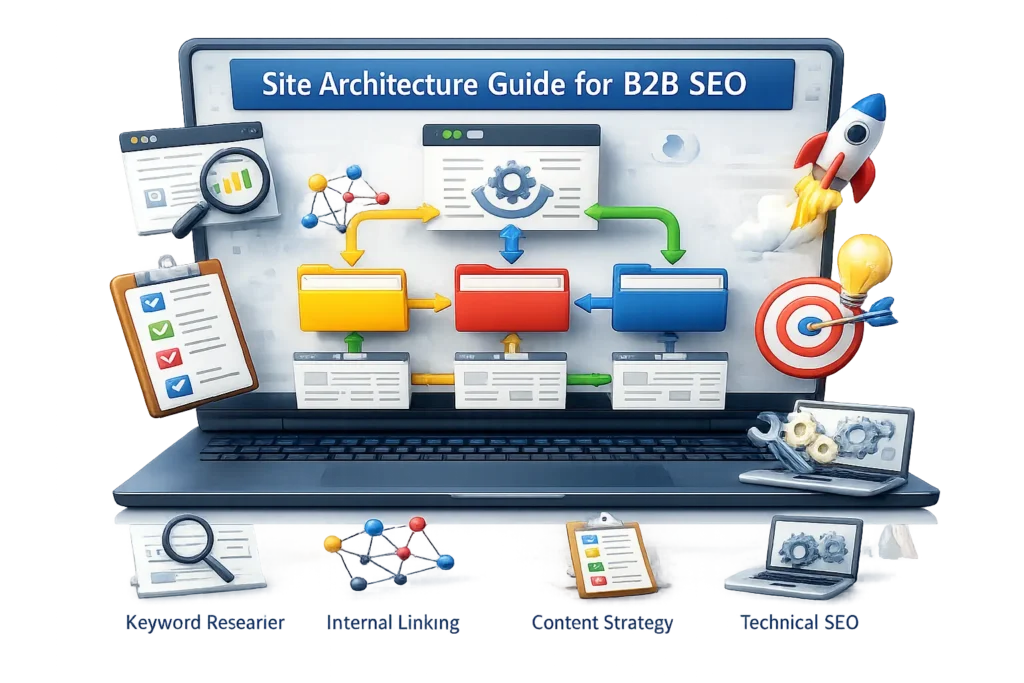
Step 2: Get Your Site Structure Right Before You Publish Anything

Most new B2B companies think about site structure only after they have already published twenty pages and things feel messy. That is the wrong order.

A clear site architecture tells Google how your pages relate to each other and which ones are most important. It also tells buyers where to go next when they land on any page of your site.

The basic structure for a new B2B website is straightforward. Your homepage sits at the top. Below it sit your core service pages. Below those sit your blog posts, case studies, and supporting content. Every page should be reachable within two or three clicks from the homepage.

Getting this right from the start means you do not have to reorganize everything six months later when it starts affecting your rankings.

Step 3: Know Exactly Who You Are Targeting

SEO without a clear target audience is just guesswork. Before you choose any keywords or write any content, you need to know exactly who your buyer is.

In B2B this means understanding what industry they are in, what their job title is, what problems they are trying to solve, and what makes them trust or distrust a vendor.

The more specific you are, the better your SEO will perform. A B2B company targeting “procurement managers in the pharmaceutical industry looking for laboratory equipment suppliers” will always outperform one that just targets “laboratory equipment.”

This specificity shapes everything. Your service pages, your content, and your keyword strategy all depend on getting this clarity right from the start.

Step 4: Build Your Service Pages Before Your Blog

Many new B2B companies jump straight into blogging and ignore their service pages. This is a mistake.

Your service pages are the pages that directly convert visitors into leads. Each service you offer should have its own dedicated page that clearly explains what you do, who it is for, what results it delivers, and why someone should trust you.

A well-optimized service page can rank and generate leads on its own without needing a blog post to support it. Think of your service pages as the foundation. Blog content builds on top of them, but they need to come first.

One B2B IT company had twelve blog posts live but no dedicated service pages. Every visitor who landed from search had no clear path to becoming a lead. Adding four properly structured service pages tripled their form submissions within ninety days.

Step 5: Choose Keywords You Can Actually Win

As a new website your domain has no authority yet. That means you cannot compete for high-volume, highly competitive keywords right away.

Instead focus on three types:

Long-tail keywords are longer, more specific phrases with lower search volume but much less competition. Instead of “packaging supplier,” target “custom packaging supplier for FMCG companies in USA.” Fewer people search it, but the ones who do are far more likely to convert. Low-volume keywords consistently outperform broad terms in B2B because the people searching them are far closer to a buying decision.

Question-based keywords are what buyers type when they are in research mode. A procurement manager searching “how to evaluate a new logistics partner” is doing early-stage research. A page that answers that question well can rank quickly and build awareness with exactly the right buyer.

Industry and location specific keywords reduce competition significantly. A B2B cleaning equipment company targeting “industrial cleaning equipment for food processing facilities in Texas” faces a fraction of the competition compared to one targeting “cleaning equipment.”

Step 6: Build Trust Signals From Day One

Google does not just look at keywords and backlinks. It evaluates whether your website signals credibility. For a brand new B2B site, this is one of the most overlooked parts of early SEO.

A real team page matters more than most founders realize. Buyers in B2B want to know who they are dealing with. A team page with real names, photos, and professional backgrounds tells both the buyer and Google that there are genuine people behind the business.

Case studies change how buyers perceive your credibility faster than almost anything else. Even one or two well-written client results from your first customers can make a meaningful difference. You do not need ten years of results to demonstrate that your approach works. You just need to document the results you do have, clearly and specifically.

Your about page needs to explain your point of view, not just your founding story. A specific perspective on how you approach your work and what makes your method different builds the kind of trust that generic pages never do.

Step 7: Build Your Content Around What Buyers Are Actually Searching

Once your service pages are in place, content is how you grow your SEO reach over time. The goal is not to publish as much as possible. The goal is to answer the exact questions your buyers are asking at different stages of their journey.

A buyer who has just realized they need a new warehouse management system has completely different questions than a buyer who is already comparing two specific vendors. Your content needs to serve both.

A B2B SaaS company had thirty blog posts, all written for buyers at the bottom of the funnel. They were getting decent traffic from branded searches but almost nothing from buyers in the awareness phase. Adding ten pieces of top-of-funnel content around common industry problems doubled their organic traffic within four months.

Organize your content into clusters where a main topic page links to several related articles and those articles link back to your service pages. This structure helps Google understand what your site is about far faster than publishing isolated posts.

Once visitors start arriving, the next challenge is making sure your website actually converts those visitors into leads. Traffic without conversion is just a vanity metric.

Step 8: Build Backlinks Strategically

A new website has no reputation in Google’s eyes. One of the most important signals Google uses to rank your pages is how many credible websites are linking to you.

For a new B2B business start small and be strategic. Get listed in relevant industry directories. Publish guest articles on industry publications. Partner with complementary businesses who can mention you on their site.

Getting other websites to link to your site takes time but it is one of the highest-leverage investments a new company can make. Two or three links from credible industry sources in your first six months can make a measurable difference in how quickly your pages start ranking.

A B2B laboratory equipment company earned three backlinks from industry association directories in their first month. Those three links alone contributed to their first five service page rankings appearing within sixty days.

Step 9: Do Not Ignore Local SEO If You Serve Specific Regions

If your B2B business operates in specific cities or regions, local SEO can be a significant source of leads that most new companies completely overlook.

Getting your Google Business Profile set up properly, getting listed in local directories, and creating location-specific pages on your website can generate visibility relatively quickly. This is especially relevant for consultants, manufacturers, and suppliers who work with clients in specific geographic areas.

A regional IT services company was getting zero organic traffic in their first four months. After setting up their Google Business Profile and creating location-specific service pages for three cities they served, they started receiving inbound calls from local searches within six weeks.

Step 10: Track From Day One

Most new B2B businesses start tracking SEO performance too late. Set up Google Search Console and Google Analytics from day one. These free tools will tell you which pages are getting impressions, which keywords you are starting to rank for, and where your traffic is actually coming from.

Without this data you are flying blind. You will have no idea whether the content you are publishing is gaining traction, whether your service pages are showing up in any searches, or whether there are technical issues quietly holding your site back.

The businesses that grow their organic traffic fastest are almost always the ones who spotted problems early because they were paying attention from the very beginning.

Your First 90 Days: What to Actually Focus On

Most guides tell you what to do but not when. Here is a realistic breakdown for a brand new B2B website.

Month one is entirely about foundation. Fix technical issues, get your site structure right, set up tracking, and optimize your service pages. Do not publish a single blog post yet.

Month two is about keyword research and content planning. Identify ten to fifteen questions your buyers are asking at each stage of their journey. Write two or three high-quality pieces targeting achievable keywords. Pursue your first two or three backlinks from directories or partners.

Month three is about building momentum. Publish consistently, add internal links between your content and service pages, and review your Search Console data to see which queries you are starting to appear for.

Jumping straight to content before the foundation is solid is the single most common mistake that sets new B2B companies back by months.

How Long Will It Take to See Results

For most new B2B websites the first three months are about building the foundation. Rankings start to move between months three and six. Meaningful lead generation typically follows after that and it compounds from there.

A B2B eLearning Platform went from Page 5 to the Top 3 in just 4 months by focusing on the right keywords and fixing technical issues that were quietly holding the site back.

A B2B Packaging Manufacturer saw meaningful improvements in search visibility within 6 months by building a structured content and on-page strategy from the ground up.

These are not outliers. They are what happens when the right steps are taken in the right order from the beginning.

DIY or Agency: How to Decide as a New B2B Company

DIY SEO makes sense in the early months if you have time to learn, you are in a relatively low-competition niche, and your budget is genuinely tight. The free tools available today are powerful enough to get a new B2B site moving in the right direction.

But DIY has a real cost that most founders underestimate. Every hour spent figuring out SEO is an hour not spent on sales, product, or operations. The opportunity cost of doing it alone quickly outweighs the cost of getting help.

New B2B companies that invest in proper B2B SEO services from the start consistently see results faster than those who figure it out through trial and error. The difference is not just speed. It is avoiding the six to twelve months of mistakes that most companies make before they understand what actually moves the needle.

Final Thought

The best time to start SEO for your B2B business was the day you launched. The second best time is today.

You do not need a massive budget or a huge team. You need a clear plan, the right starting point, and consistent execution. Start with your technical foundation, get your site structure right, optimize your service pages, and choose keywords you can realistically win.

SEO compounds over time. Every page you publish, every backlink you earn, and every technical issue you fix adds to a foundation that keeps working for you long after the initial effort is done. The businesses that start this process early and stay consistent are the ones that end up owning their category in search while their competitors are still waiting for referrals.

Leave a Comment

Your email address will not be published. Required fields are marked *

Scroll to Top