B2B SEO for New Companies: A Step-by-Step Guide to Getting Started

Starting a new B2B business means juggling a hundred things at once. Your team, your service, your first few clients.

Somewhere in that list, someone tells you that you also need SEO.

The problem is that most SEO advice online isn’t written with B2B buyers in mind. Buyer behavior can be different here. Sales cycles may run longer, and decisions often involve more than one person.

This guide is written specifically for new B2B companies. It walks through exactly where to start, in the right order, without wasting time or money along the way.

Why SEO Works Like a Sales Activity in B2B

B2B buyers rarely make quick decisions. Before reaching out to a company, many spend time researching quietly on their own.

They read articles. They compare a few vendors. They look for information that helps them decide whether a company is worth considering.

If your website doesn’t show up during that research window, you may miss the chance to become part of the buyer’s consideration process. A competitor with stronger visibility may get noticed instead.

By the time some buyers finally reach out, they may already have researched several options and formed an initial opinion.

What This Can Cost You

This kind of situation can happen across different B2B industries, whether it’s a logistics company, a SaaS platform, or a firm selling industrial machinery.

Picture a staffing agency competing for a large contract. The buyer may have spent time reading another company’s articles and quietly comparing different options before ever picking up the phone.

If the staffing agency had little content and limited search visibility during that period, it may not have been considered as seriously as a competitor that appeared throughout the research process.

Why This Makes SEO a Sales Function, Not Just Marketing

This is why SEO can support the sales process in B2B, rather than working only as a marketing activity.

Every useful page that ranks can answer questions and introduce buyers to your company. This can happen before your team ever gets on a call.

The Biggest Mistake New B2B Companies Make

Many new B2B companies fall into one of two traps. They either do nothing and depend mainly on referrals, or they try to compete for broad, highly competitive keywords far too soon.

Both approaches can create problems.

Doing nothing can limit your visibility among buyers who are actively searching for what you offer. Chasing broad keywords too early can put a new website against companies with years of authority and large content libraries.

A smarter approach is to start narrow, build systematically, and expand outward once you’ve earned some traction.

Step 1: Fix Your Technical Foundation First

Before writing a single blog post, your website needs to work properly. A slow site, broken pages, or a clunky mobile experience can make your other SEO efforts less effective.

Most new companies skip this step because it feels less exciting than publishing content. But technical issues can remain unnoticed in the background and affect the work being done elsewhere on the site.

Picture a consulting firm publishing articles regularly for months but seeing very little progress in search. Later, the team discovers that a technical issue has been preventing important pages from being crawled properly.

A situation like this shows why technical checks should come before large-scale content publishing. Fixing the foundation first can prevent good content work from being held back by avoidable technical problems.

The same risk can appear on manufacturing websites too. A supplier might have hundreds of product pages, but slow loading times or repeated descriptions can make it harder for many of those pages to perform well in search.

The Non-Negotiables

At a minimum, your site needs to check these boxes before you publish anything else:

  • Loads quickly on both desktop and mobile
  • Works properly on a phone screen, not just a laptop
  • Has no broken internal or external links
  • Is correctly indexed by Google, with no accidental blocks
  • Has no large blocks of duplicate or near-duplicate content

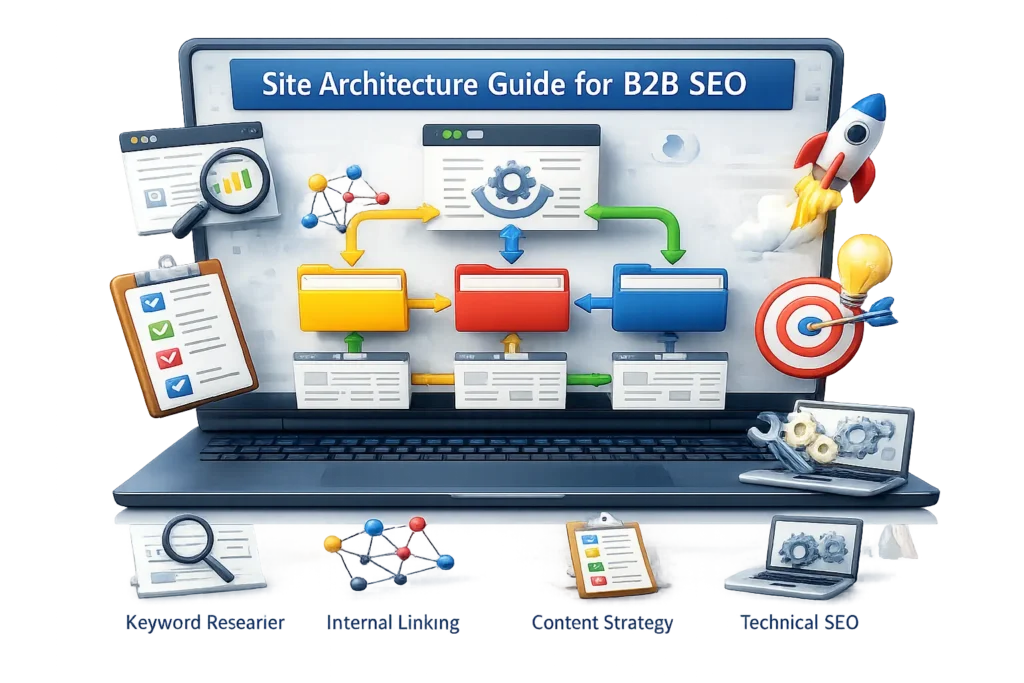
Step 2: Get Your Site Structure Right Before You Publish

Most new companies think about site’s structure only after they’ve already published twenty scattered pages and things start feeling messy.

A clear structure helps search engines understand how your pages connect to each other and which pages are more central to the site. It also helps visitors understand where they can go next.

The Basic Layout

The basic layout is simple. Your homepage sits at the top.

Your core service pages sit just below it, and your supporting content sits below that.

What Happens When Structure Is an Afterthought

Picture a logistics company serving five different regions, each with its own page but no clear connection back to the homepage or to each other.

A visitor landing on one of those pages may have no obvious next step. Connecting the regional pages to a central hub can create a clearer path through the site.

It can also make the overall structure easier to understand.

Getting this right early can reduce the need for a major reorganization later, once the website has grown and the existing structure has become harder to manage.

Step 3: Know Exactly Who You Are Targeting

SEO without a clear target audience can easily become guesswork. Before picking a single keyword, you need real clarity on who your buyer actually is.

In B2B, this means understanding their industry, their job title, the specific problem they’re trying to solve, and what they may look for when comparing vendors.

The more specific this picture is, the easier it becomes to make focused decisions about pages, topics, and keywords.

Why Specificity Wins

Take a company that sells lab equipment.

Targeting “procurement managers at pharmaceutical companies looking for lab equipment suppliers” works far better than targeting the broad term “lab equipment.”

The same logic applies in fintech. A payments company writing for finance teams at mid-size retailers will create very different content than one writing for any business that needs payment processing.

This specificity guides every decision that follows. It shapes your service pages, your articles, and the keywords you choose to target.

Step 4: Build Your Service Pages Before Your Blog

Many new B2B companies jump straight into blogging and neglect their service pages entirely. This can leave an important gap in the website.

Service pages give interested visitors a clearer path toward learning about what you offer.

Each service deserves its own page explaining what you do, who it’s for, and why someone should consider working with you.

A well-built service page can attract relevant search traffic and give interested visitors a clear next step, even before a large supporting blog strategy is in place.

No Service Pages, No Clear Path to a Lead

Picture an IT company with a dozen blog posts live, but no dedicated service pages at all.

Visitors may read the content and still struggle to understand exactly what the company offers.

Adding a few properly structured service pages can give those visitors a clearer next step. Each page can focus on one service, explain who it is for, and make the path towards an enquiry easier to understand.

Thin Pages Cost Leads Too

A quieter version of the same problem can appear when a healthcare software company’s blog performs well, but its actual product pages stay thin and vague.

Rebuilding those pages with clearer details about integrations and compliance credentials can answer important questions.

This may help interested visitors make a more informed decision about contacting the company.

Step 5: Choose Keywords You Can Actually Win

A new website usually begins with limited search authority and visibility. This can make high-volume, highly competitive keywords difficult to compete for in the early stages.

Instead, focus on keywords that are more specific and closely connected to what your buyers need.

There are three types worth understanding.

Long-Tail Keywords

These are longer, more specific phrases that often have lower search volume and more focused intent.

A packaging company targeting “custom packaging for food brands shipping internationally” would attract a different audience than one targeting “packaging supplier.”

The longer phrase may receive fewer searches, but people using it are looking for something more specific. That can make the traffic more relevant to the service being offered.

Question-Based Keywords

These capture buyers who may still be in research mode.

A logistics manager searching “how to reduce late deliveries without hiring more drivers” is thinking through a problem and may not be ready to compare vendors yet.

A useful page answering that question can introduce the company during the research process. It can also give the buyer a reason to explore related content or services.

Industry and Location-Specific Keywords

These keywords can make the targeting more focused.

An industrial equipment supplier could target “packaging line equipment for food manufacturers in Texas” rather than relying only on the broad term “packaging equipment.”

The same logic applies to professional services.

A consulting firm targeting “operations consulting for mid-size manufacturers” may reach a more relevant audience than one focusing only on generic terms such as “business consulting.”

Step 6: Build Trust Signals From Day One

Keywords and links are only part of building an effective website.

Your site should also make it easy for visitors to understand who is behind the company and why they should consider working with it.

This becomes especially important for a new B2B company that potential buyers may not already know.

A Real Team Page

A real team page can help buyers understand who they’re actually dealing with before they consider starting a business relationship.

A page with real names, real photos, and clear professional backgrounds gives visitors more context about the people behind the business.

Honest Case Studies

Case studies can help potential buyers understand what a company has actually done for its clients.

Even one or two honest examples from early projects can add useful proof to a new website.

Picture a fintech company with only a few completed client projects. It could turn them into detailed case studies that explain the challenge, the work completed, and the results that can be verified.

These case studies can give early prospects a clearer picture of the company’s capabilities. They also provide more useful context than generic promotional statements alone.

An About Page With a Point of View

Your about page should explain your actual point of view, not just your founding story.

A specific perspective on how you approach the work can make the page more useful and memorable for potential buyers.

Step 7: Build Content Around What Buyers Are Actually Searching

Once your service pages are solid, content can become an important part of growing your reach over time.

The goal isn’t publishing as much as possible.

The goal is answering the questions your buyers are asking, at whatever stage they happen to be in.

A buyer who just noticed a problem searches very differently from one already comparing two named vendors. Good content should support different stages instead of focusing only on people who are ready to buy.

When Content Only Serves One Stage

Imagine a SaaS company reviewing its own blog and finding that most of the content is written for buyers already comparing vendors.

The company could expand its content around common industry problems and early-stage questions.

A few useful articles covering these topics would help the site support more stages of the buying journey.

A manufacturing equipment company might run into the same problem from a different angle.

Its content answers “how does this machine work,” but never addresses questions such as “why do our production lines keep breaking down.”

Why Content Clusters Work Better Than Standalone Posts

Organizing content into clusters can make related pages easier to connect.

A central topic page links to several related articles, and those articles can link back to relevant service pages.

This structure creates clearer relationships between related pages. It can also help visitors move between topics without relying on scattered, disconnected posts.

Step 8: Build Backlinks Strategically

A new website often starts with limited authority and few external signals.

Relevant links from credible websites can support visibility and help more people discover the business.

For a new B2B business, start small and deliberate. Get listed in relevant industry directories, contribute guest articles to trade publications, and look for genuine collaboration opportunities with complementary businesses.

A Fast Start From Directory Links

Relevant industry directories and trade associations can be a sensible starting point for a new B2B website.

Begin by finding a few credible websites that are closely related to your industry. Focus on relevance and quality instead of trying to collect a large number of directory links quickly.

A Slower, Steadier Path Through Guest Content

Guest content works better as a steady activity than a short burst of mass outreach.

A professional services firm could contribute a few useful articles to relevant industry publications over time.

The goal should be to share genuinely useful knowledge while building visibility and relevant connections around the business.

Step 9: Don’t Ignore Local SEO If You Serve Specific Regions

If your B2B business operates in specific cities or regions, local visibility is worth considering.

Setting up a proper Google Business Profile, getting listed in relevant local directories, and building useful location-specific pages can support visibility for regional searches.

From Zero Traffic to More Local Visibility

Picture an IT services company serving three different cities but using only one general service page for all of them.

Building dedicated location pages could make the website more relevant to each service area.

The company could also improve its Google Business Profile and keep its business details consistent across relevant local listings.

Splitting One Page Into Five

A commercial equipment supplier serving five states might have one broad page trying to cover every location at once.

Splitting that page into five dedicated regional pages can make the information more useful for visitors in each area.

Each page can focus on the services available there, the locations covered, and the needs of buyers in that region.

Step 10: Track Everything From Day One

Many new B2B businesses start tracking performance later than they should.

Set up analytics and search tracking tools from day one, rather than waiting until months of work have already passed.

These tools show which pages are getting impressions, which keywords you’re starting to appear for, and where your traffic is actually coming from.

Without this data, it becomes difficult to judge what is working.

You may not know whether content is gaining traction, whether service pages are appearing in relevant searches, or whether a technical issue needs attention.

Companies that monitor performance from the beginning can identify problems earlier. They can also make changes based on actual data rather than assumptions.

How Long Results Actually Take

There is no fixed timeline for a new B2B website.

Some sites begin showing progress earlier, while others need much more time.

The early stage usually involves fixing technical issues, improving important pages, and publishing useful content.

The pace of progress can depend on competition, website authority, resources, and the quality of execution.

Lead generation can also take time. SEO is generally better treated as a long-term growth channel than as a source of immediate results.

Should You Do This Yourself or Bring in Help

Doing SEO yourself can make sense early on, especially if you have time to learn, operate in a relatively low-competition niche, and have a genuinely tight budget.

But DIY SEO also uses time that could be spent elsewhere.

Every hour spent learning and executing SEO is an hour that cannot be spent on sales, product, or client work.

ApproachWorks Best WhenReal Cost
DIYLow-competition niche, tight budget, time to learnHours pulled away from sales, product, and clients
Getting HelpCompetitive niche, faster execution needed, budget availableUpfront spend, but may reduce trial and error

That opportunity cost is worth considering.

In some situations, learning and managing SEO internally makes sense. In others, bringing in experienced help may be more practical.

Working with a B2B SEO agency can provide access to experience and a clearer process.

It may also help a company avoid common mistakes that come from learning every part of SEO through trial and error.

The real advantage isn’t a guaranteed timeline or ranking position.

It is having a structured strategy and making decisions with more experience behind them.

Final Thought

Starting SEO early can give a B2B company more time to build its search presence.

But the right time to begin will still depend on the company’s priorities, resources, and current stage.

None of this requires a massive budget or a large team.

It requires a clear plan, the right starting point, and consistent follow-through.

Start with the technical foundation. Get the site structure right. Build out service pages properly. Choose keywords that make sense for your current stage.

SEO efforts can build on each other over time.

Useful pages, relevant links, and technical improvements can all contribute to a stronger website.

Companies that start early and stay consistent may put themselves in a stronger position to build long-term search visibility instead of depending only on referrals.

Leave a Comment

Your email address will not be published. Required fields are marked *

Scroll to Top